

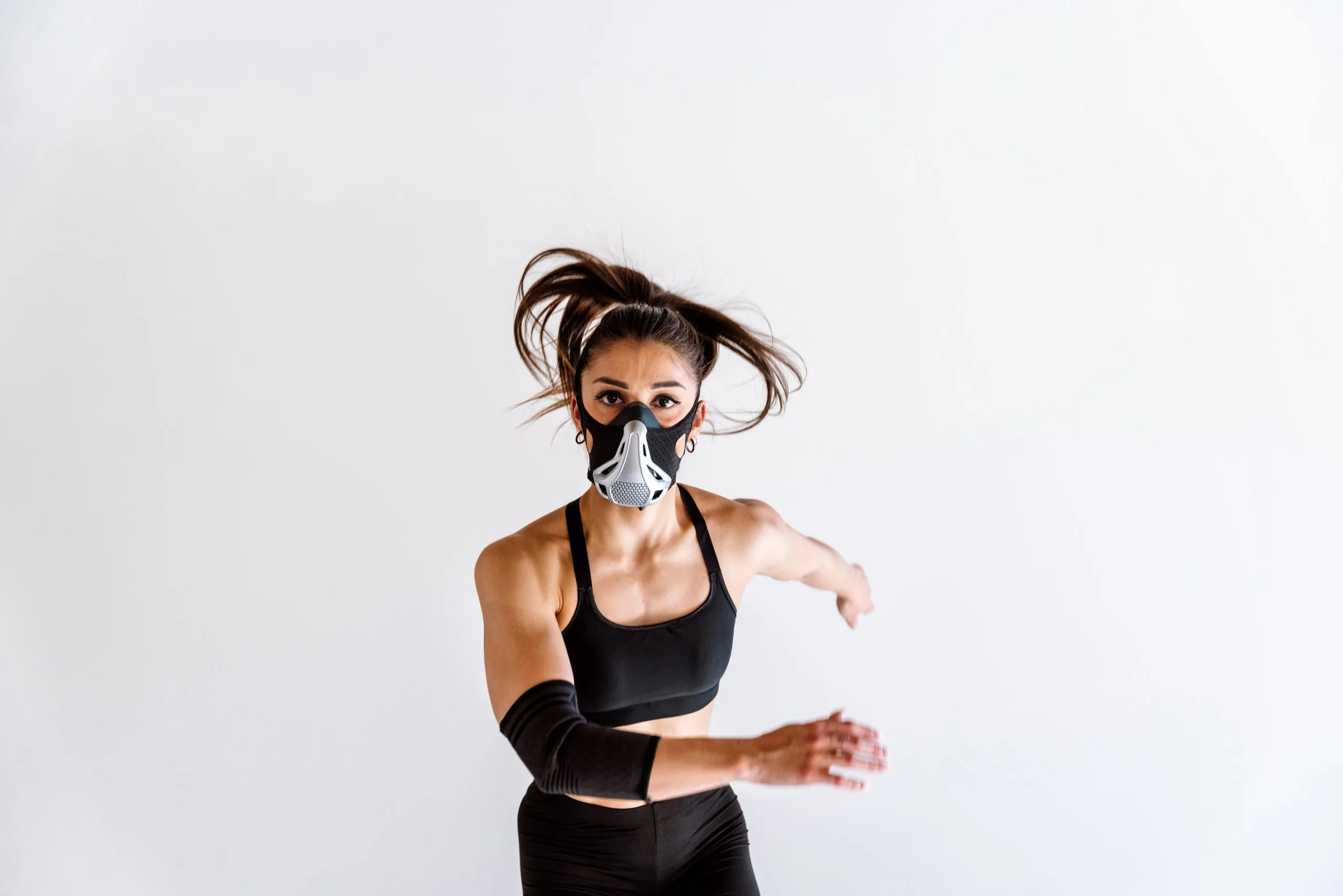
You’ve probably seen them at the gym – those black, vented masks that make people look like they’re training for a SWAT team. They’re popular on social media, worn by athletes and fitness enthusiasts who swear they’re a game-changer. Here’s what most people don’t know: not all altitude training masks are created equal.
The cheap resistance masks you find online are a very different animal from clinical-grade hypoxic training systems, and understanding that difference is the key to knowing whether altitude training is right for you.
The confusion around altitude masks starts with the fact that two completely different products share the same nickname.
Resistance masks (the kind you’ll find for $30–$80 on Amazon) work by restricting airflow. They make it physically harder to inhale, which trains your breathing muscles, but they don’t change the oxygen content of the air. Your lungs still receive normal oxygen concentrations. These masks have a narrow application and don’t deliver true altitude adaptation.
Hypoxic training systems – like the Hypoxico Everest Summit II that we offer here at Evolution Healthcare – work on an entirely different principle. They use a generator to actively reduce the oxygen concentration in the air flowing through the mask, accurately replicating the thin-air environment of high elevations. This is the same science used by Olympic programs, military conditioning units, and elite endurance coaches around the world.
When people debate whether altitude masks “work,” they’re usually talking about the first category. We’re here to talk about the second.
At real altitude – say, 10,000 feet above sea level – the air contains fewer oxygen molecules per breath. Your body responds to this challenge in remarkable ways. Over time, consistent exposure triggers measurable physiological adaptations:
Increased red blood cell production, improving your blood’s oxygen-carrying capacity
Enhanced mitochondrial density, making your muscles more efficient at using oxygen
Improved cardiovascular efficiency, so your heart doesn’t have to work as hard at any given intensity
Greater buffering capacity, helping your muscles tolerate lactic acid buildup longer
These are not minor tweaks. They’re the same adaptations that make high-altitude athletes – think marathon runners or Tour de France cyclists – so formidable at sea level. The difference is that most people can’t pack up and move to a mountain. A clinical hypoxic system brings the mountain to you.
The evidence for hypoxic training is well-established in sports science. Studies have consistently shown that athletes who combine hypoxic exposure with exercise see meaningful improvements in VO2 max (a key marker of cardiovascular fitness), time-to-exhaustion, and race performance compared to sea-level training alone.
A large body of research supports the “live high, train low” model – in which athletes regularly expose themselves to hypoxic conditions and then perform their hardest training at normal oxygen levels. Hypoxic generators make this model accessible outside of elite training facilities.
The benefits aren’t limited to competitive athletes either. Research has also explored hypoxic training for:
Weight management and metabolic health
Improving insulin sensitivity
Accelerating recovery from certain musculoskeletal injuries
Supporting cardiovascular conditioning in people who can’t sustain high-intensity exercise at sea level
True hypoxic training is a powerful tool, and like any powerful tool, it works best when matched to the right person and goal.
Endurance athletes – runners, cyclists, triathletes, swimmers – are the classic candidates. If pushing your aerobic ceiling is the goal, hypoxic exposure is one of the most evidence-backed methods available.
Strength and power athletes looking for a cardiovascular edge without sacrificing their lifting program can strategically incorporate hypoxic sessions alongside strength work.
Fitness enthusiasts who’ve plateaued often find that altitude training introduces a new stimulus that breaks through stagnation in ways that simply doing “more of the same” doesn’t.
People focused on metabolic health, including those working on weight management or blood sugar regulation, may find hypoxic training a compelling addition to a comprehensive wellness plan.
For those who want to experience genuine altitude training, we offer the Hypoxico Everest Summit II generator – a clinical-grade system that can simulate elevations up to 20,000 feet. You can use it anywhere in our primary gym space, whether you’re on the cardio equipment or working through a strength session. A mask is available at the front desk for $65, and a supplemental waiver is required before your first session.
This isn’t a gimmick product or a marketing shortcut. The Hypoxico system is used by serious training programs worldwide precisely because it delivers on the science. Having it available as part of your training at Evolution Healthcare means you don’t need an elite sports contract or a trip to the Rockies to access one of the most effective performance tools in modern fitness.
Our team is here to help you use it well. That means understanding your current fitness baseline, your goals, and how altitude sessions fit within your broader program – whether that includes Chiropractic care, physical therapy, personal training, or all three.
Hypoxic training is safe and effective for most healthy individuals, but it does deserve respect as a physiological stressor. A few guidelines worth knowing:
Start conservatively. Lower simulated altitudes and shorter sessions are the right entry point. Adaptation is gradual, and more isn’t always better early on.
Stay hydrated. Hypoxic environments increase fluid loss and can accelerate dehydration.
Listen to your body. Lightheadedness, headache, or unusual fatigue are signals to dial back intensity or altitude level.
Medical clearance matters. People with cardiovascular conditions, high blood pressure, severe anemia, or respiratory disorders should speak with a healthcare provider before beginning hypoxic training.
Our staff can walk you through what to expect and ensure your first sessions are comfortable and productive.
Altitude training – done right, with the right equipment – is one of the most scientifically supported performance tools available. The key phrase is done right. A generic resistance mask from the internet isn’t the same as a calibrated hypoxic generator backed by decades of sports science. If you’ve been curious about whether altitude training could work for you, it’s a conversation worth having.
Stop by the front desk, ask about the Hypoxico Everest Summit II, and let’s talk about how it fits into your goals. Whether you’re training for a race, recovering from a setback, or simply looking to push past where you are right now – we’re here for it.
Questions about altitude training or any of our services? Reach out to the Evolution Healthcare team, and let’s build the right plan for your body.

About the Author
Brad Farra